What the water carried
The strait moved things in both directions — language, liturgical practice and building knowledge among them.
- Entry
- A.4
- Where
- Both shores
- Period
- Antiquity to the modern era
- Section
- The Strait
01The exchange was never one-way
Traffic through the Strait of Otranto is usually described as emigration: Albanians crossing west after the Ottoman consolidation of the fifteenth century, settling in Calabria, Sicily, Apulia. That account is true but incomplete. The strait was a working channel, not a one-way gate, and what it transmitted was cultural as well as human.
The Arbëresh settlers who established communities in southern Italy brought with them a form of Albanian that had already diverged from the varieties still spoken on the eastern shore, a Byzantine liturgical rite that Rome eventually recognised rather than suppressed, and building habits formed in a landscape of stone and slope. Those communities then developed in relative isolation for five centuries, which is precisely why their language and rite survived: separation preserved what contact would have gradually dissolved.
Ottoman craftsmen added geometric tilework and timber-screened upper rooms; neither tradition simply replaced the other.
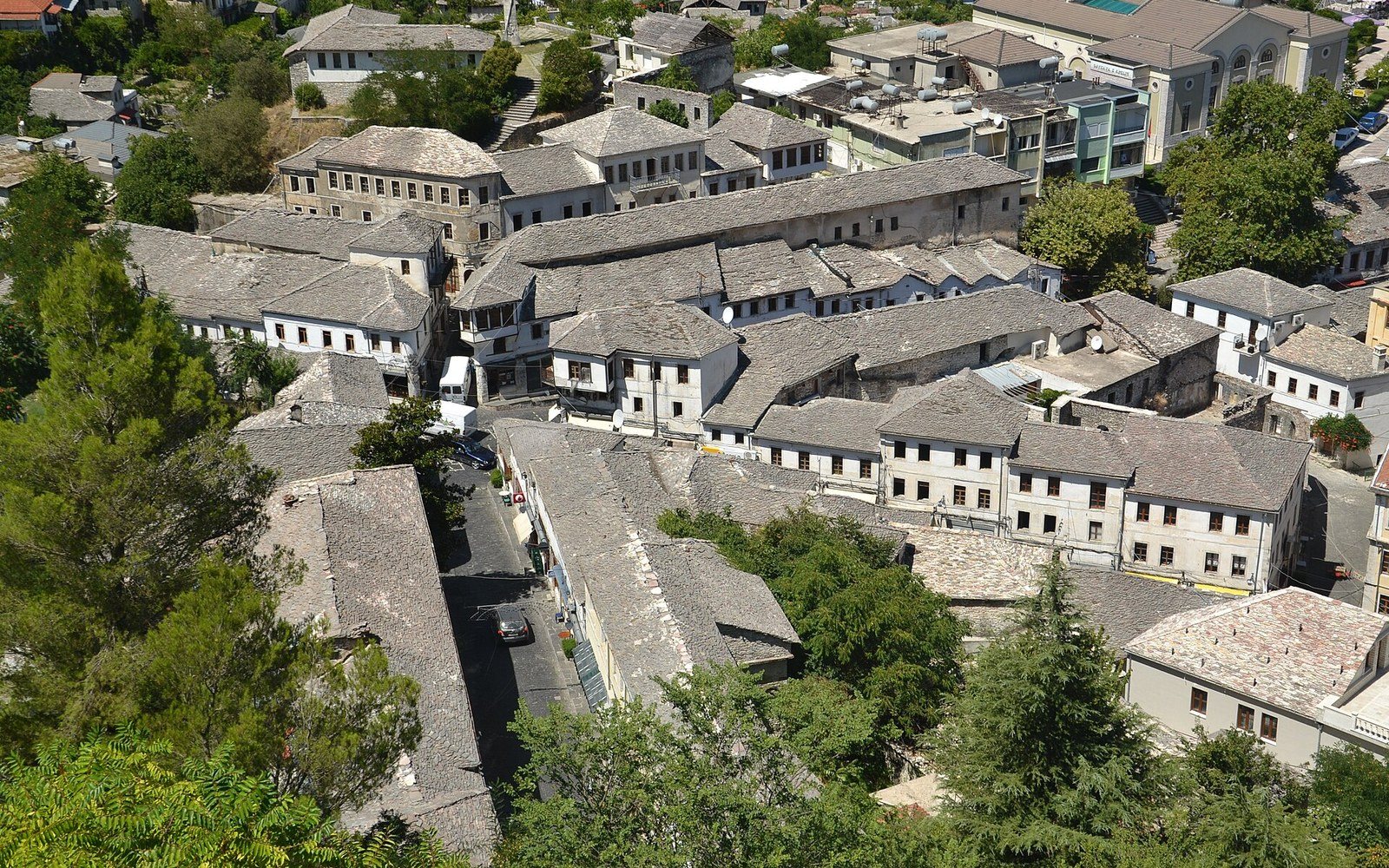
But transmission also ran east. Venetian masons, builders of the coastal fortresses and loggia towns that remain readable in Durrës and Shkodër, left a vocabulary of cut stone, round arch and courtyard that Albanian builders absorbed and adapted. The kulla — the northern tower-house with its thick walls and defended lower storey — reads partly as a local answer to a Mediterranean building type that arrived via trade and occupation. Ottoman craftsmen added geometric tilework and timber-screened upper rooms; neither tradition simply replaced the other.
The liturgical exchange is the most durable. The Byzantine rite that the settlers carried west was already a hybrid: Greek in its formal language, Albanian in its sung vernacular, Adriatic in the saints it emphasised. It crossed the strait as a complete practice and then adapted again in Italy, accumulating Latin elements while retaining the eastern calendar and the iconostasis. The result is a rite that belongs to neither shore entirely, which is the most honest record of what the water actually carried: not pure originals, but things already in motion, changed by the crossing, changed again by arrival.
- Fifteenth centuryOttoman consolidation prompts Albanian settlement in southern Italy
- Venetian presence on the Albanian coastfortresses, loggia towns, cut-stone vocabulary adopted by local builders
- Five centuries of Arbëresh isolationthe condition that preserved language and rite in a recognisable form